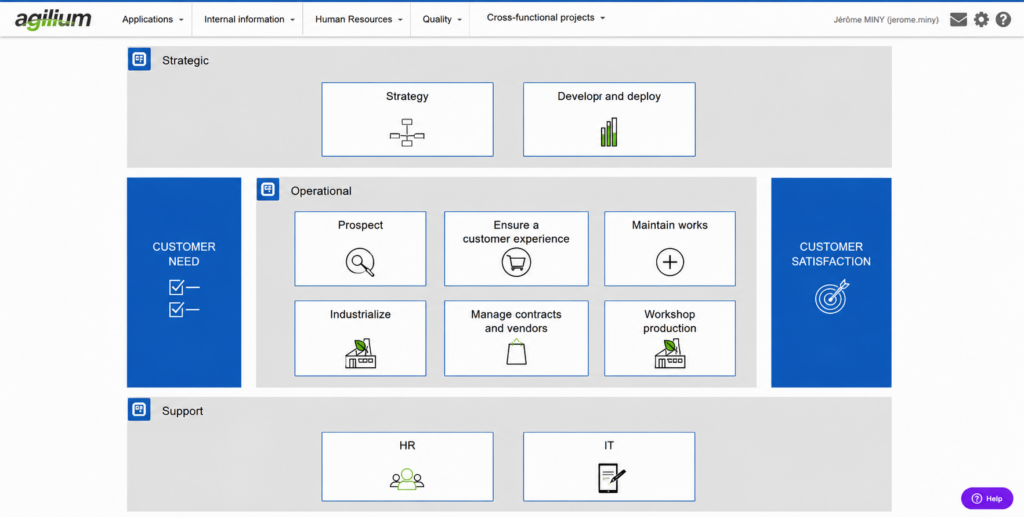


A useful process map should provide a quick understanding of:
– What are the organization’s processes?
– Who manages them?
– How do they relate to one another?
– What documents, metrics, risks, and actions are associated with them?
Even though it only shows boxes and arrows, it helps with drawing—not with flying.
What is process mapping?
A process map is a visual representation of an organization’s activities and how they interact with one another.
In a quality assurance process, it is generally used to highlight three main categories:
– management processes;
– implementation processes;
– support processes.
Its purpose is simple: to make the organization’s structure clear. It often serves as the starting point for linking documentation, process descriptions, metrics, risks, audits, and action plans.

What is the practical purpose of process mapping?
Good mapping isn’t just about documenting the current state. It also helps ensure the quality system functions properly.
Make the organization easier to understand
When processes remain implicit, everyone compensates in their own way. Mapping brings a shared vision back to the table.
Clarify Responsibilities
It allows you to see who is in charge of what, where the interfaces between services begin, and where gray areas arise.
Bringing the QMS to Life
A map becomes truly useful when it is not isolated. It should make it easy to locate the documents, reviews, indicators, risks, and actions associated with each process.
What does a good process mapping template include?
Process mapping is not intended to cover everything. It serves as a starting point.
It should allow users to navigate intuitively to other elements:
- the process name and its description
- his family: directing, producing, or support;
The elements of the process sheet
- the requirements,
- comments;
- the objectives;
- a release date;
- the process driver;
- the purpose of the process;
- its main activities;
- its input data;
- its output data;
- the roles or individuals responsible for each step;
- its main interactions;
- Resources mobilized: internal staff, service providers, equipment;
- the relevant stakeholders;
Related documentation:
- the related documents or forms;
- access to the downloadable process sheet;
- a flowchart to visualize the process;
QMS Data
- process monitoring indicators,
- related actions,
- risks and opportunities,
- nonconformities related to this process,
- a SWOT analysis,
- the list of process reviews,
Download the process mapping template
Writing Guide and Templates
What’s the best way to bring your process map to life?
Creating this map in software completely changes how it’s used on a daily basis.
We no longer rely on a static diagram set out in a document: each process becomes navigable, linked to its detailed description, documentation, templates, flowchart, metrics, and associated actions.
Teams can access useful information more easily, without having to search through multiple scattered files or folders.
The code is easier to read, the relationships between processes are clearer, and the system remains easier to maintain over time.
When you add automatic reminders, notifications, and centralized updates, mapping is no longer just a way to represent the organization—it becomes a true management tool.
Download our process mapping template
This document is a comprehensive guide to process mapping, designed to help organizations structure, visualize, and better manage their quality system.
It combines educational explanations, concrete examples of flowcharts and process maps, and practical guidelines for linking processes, documentation, and continuous improvement.
His main point is to show that useful mapping should not remain theoretical: it must be clear, kept up to date, and directly applicable to operational management.
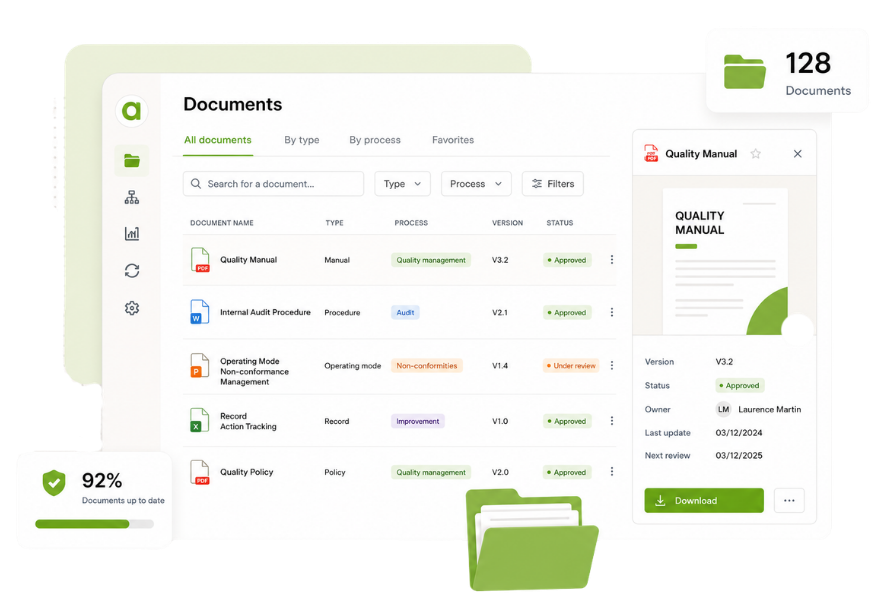
Télécharger le plaquette du logiciel de GED qualité ISO 9001 : Agilium
Découvrez les écrans de la solution
Case Study: How UPEC Brought Its Process Map to Life
UPEC’s experience is interesting because it demonstrates a more sophisticated use of mapping in a complex context.
The university has digitized its quality system across multiple sites, involving several entities and multiple quality certifications to manage. In this context, the mapping was not intended to be a single, static image.
It has been adapted in several ways:
– at the institutional level;
– at the unit level;
– at the business domain level.
This approach is particularly useful in organizations where the diversity of job roles makes a single perspective insufficient.
- Coût
- Conformité ISO 9001 native
- En-têtes/pieds de page automatisés
- Workflow de validation tracé
- Suivi des évolutions normatives
- Autonomie de l'équipe qualité
Le message n’est pas “il faut absolument une GED, à tout prix”. C’est plutôt : si l’objectif est une conformité ISO 9001 fiable et durable sur le documentaire, mieux vaut choisir un outil nativement conçu pour ça qu’un outil généraliste à faire évoluer indéfiniment.
FAQ : GED et ISO 9001
Faut-il obligatoirement une GED pour être certifié ISO 9001 ? Non, la norme n’impose aucun outil précis. Elle impose des résultats : traçabilité des versions, statuts clairs, accès contrôlé au document officiel, preuve de validation. Une GED est le moyen le plus fiable d’obtenir ces résultats sans effort manuel permanent, mais ce n’est pas une exigence textuelle.
Est-ce que SharePoint suffit pour être conforme ISO 9001 ? SharePoint couvre une partie du sujet (versioning technique, permissions), mais pas nativement le cycle de vie qualité (statuts métier, workflow de validation, en-têtes automatisés, archivage des documents obsolètes). Il peut être rendu conforme, mais au prix d’un paramétrage ou d’un développement spécifique. Et le vrai piège est là : un prestataire SharePoint ne suit pas les évolutions des normes ISO de son propre chef. À chaque mise à jour du référentiel, c’est à l’entreprise de repérer le changement, de le demander explicitement, puis de payer un nouveau développement pour rester conforme. Concrètement, la GED n’est jamais “finie” : c’est un casse-tête à maintenir année après année, alors qu’un éditeur de logiciel qualité fait évoluer son produit pour tous ses clients en même temps, sans surcoût à chaque révision de norme.
Peut-on être ISO 9001 avec une démarche 100 % papier ? En théorie oui, rien dans la norme n’interdit le papier. En pratique, c’est la voie la plus difficile à tenir : traçabilité fragile, risque de perte, impossibilité de démontrer rapidement en audit qui a eu accès à quelle version. Peu d’entreprises certifiées fonctionnent encore ainsi au-delà d’une poignée de collaborateurs.
Combien coûte une GED qualité ISO 9001 ? Cela dépend de l’approche. Un développement sur mesure sur une plateforme généraliste type SharePoint se chiffre souvent en dizaines de jours de prestation. Une gestion électronique documentaire qualité nativement conforme, comme le module GED d’Agilium, démarre à 79 €/mois en abonnement (+ un coût de déploiement d’environ 1 500 €), sans développement additionnel pour couvrir les exigences documentaires de la norme.